There comes a point when configuring a Porsche stops being about choosing options.
It becomes about eliminating everything that does not belong.
I think I reached that point after more than fifty years of having the 911 somewhere in my life.
My first experience with one came as a child in Europe, sometime between 1968 and 1972. My sister and I were given a ride in a 911 driven by a racing driver at a motorsport-related gathering. I remember very little about the day itself. What I remember is the car.
More specifically, I remember the conversation taking place between the driver and the car.
I didn't have words like weight transfer, chassis balance, steering feedback or slip angle. I was just a little boy. What I understood was that the driver seemed to know what the car was going to do before it did it.
The Porsche was telling him.
That became my earliest benchmark for what a machine could be.
Decades later I owned a black 911 Turbo and put approximately 54,000 miles on it. It confirmed what that childhood ride had somehow planted in my head: the numbers matter, but the relationship matters more.
That Turbo eventually left my garage, but the benchmark stayed.
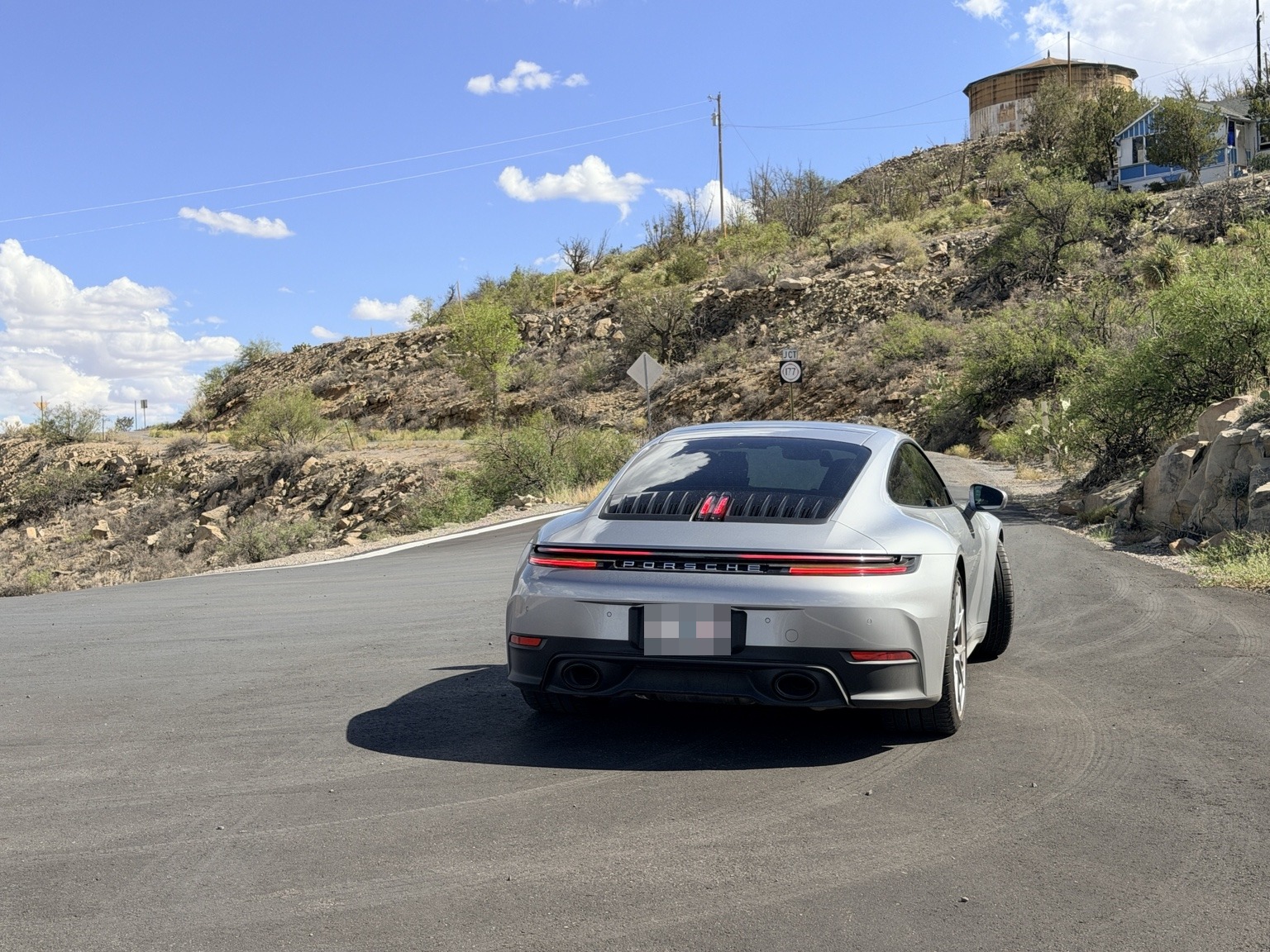
Today I drive a GT Silver Carrera S that I call Silver Ghost.
Ghost is an extraordinary 911, and I've never considered it a consolation prize. When I learned how long the wait for the GTS I really wanted might be, the Carrera S became something else entirely.
It became the bridge.
It gave me a 911 to drive while I figured out exactly what the next one needed to be.
And that distinction matters.
Because I wasn't trying to configure the most expensive 911 I could afford.
I wasn't trying to build the fastest one.
I certainly wasn't trying to build the one somebody else would choose.
I wanted to build my Porsche.
Why a GTS?
The first decision was actually the easiest.
GTS.
Porsche has always been exceptionally good at creating distinctions that don't necessarily reveal themselves in a parking lot.
A Turbo announces itself.
A GT3 has a purpose that is immediately understood.
The GTS occupies a different place.
To me, it represents that wonderful middle ground Porsche understands so well: serious performance without requiring the car to become exclusively about performance.
I want a 911 that can spend an entire day attacking mountain roads and then carry my wife and me across several states.
I want something that feels special at 70 mph without needing to be doing 170.
I want capability that is always present but doesn't constantly demand that I prove it exists.
That's the GTS.
There is also something else about it that appeals to me.
You have to know what you're looking at.
That idea would eventually influence almost every exterior decision I made.
Why the Targa?
The Targa was more complicated.
A Carrera would have been the obvious answer. In many ways, it is the purest expression of the 911 shape.
A Cabriolet gives you the full open-air experience.
The Targa does neither.
And somehow, that became exactly why I wanted it.
The Targa exists between two worlds.
Roof closed, it still has the intimacy and structure of a 911. Open it, and the entire character of the experience changes. Then there is that unmistakable Targa bar, a design element that connects the current car directly to Porsche history.
The open roof is also a quiet nod to my motorcycle past. It keeps the sky, the wind and the changing air inside the experience—the part of travel a motorcycle teaches you never to take for granted.
That matters to me.
I don't want the past recreated.
I want it acknowledged.
There is a difference.
Porsche is at its best when it doesn't imitate its history but allows that history to remain visible underneath everything it has learned since.
The Targa does that beautifully.
And because I intend to drive this car rather than preserve it as an object, the Targa 4 GTS made even more sense.
All-wheel drive.
GTS performance.
Open-air driving.
A configuration capable of being a serious driver's car while still being something Retha and I can point toward a distant road and simply go.
That's what I wanted.
Then Came the Color
Color nearly drove me insane.
There are colors that make a 911 beautiful.
There are colors that make one dramatic.
There are colors that make one unmistakably Porsche.
GT Silver is one of them. Living with Ghost has only reinforced how beautifully that color works with the 911.
Guards Red is another. There may be no more immediately recognizable combination than a Guards Red Porsche 911.
Amethyst Metallic came early in the process.
I loved it. Retha loved it as much as I did.
It is deep, dramatic and constantly changing. It can look almost black until the light finds the purple underneath. It was exactly the kind of color I am usually drawn to—uncommon, layered and impossible to understand from a photograph.
Even then, Irish Green was always the choice. I waffled between GT Silver, Guards Red, Amethyst and the other colors that caught my eye, but Irish Green was the one I kept returning to.
The longer I lived with the idea, the more I realized that Amethyst did not fit this GTS.
It was a beautiful answer to a different question.
Irish Green doesn't shout.
It doesn't need to.
It has history without looking old. In sunlight it comes alive. In softer light it becomes deep, restrained and almost formal.
Most importantly, it works with the shape rather than competing with it.
That became important because I wasn't building the car around a color.
I was building a complete composition.
Irish Green became the foundation.
Irish Green carries its own quiet lineage. It was the color of Ferry Porsche's first company 911 and, more than half a century later, the one-millionth 911. One of Ferry's favorites, it lets this GTS nod toward where the 911 began without trying to recreate it.
Cognac
Once Irish Green was chosen, black would have been easy.
Too easy.
I wanted the interior to have warmth.
Cognac gave me that.
Irish Green and Cognac together have an almost old-world quality without turning the car into a nostalgia exercise. The combination could have existed decades ago, yet inside a modern 911 it feels completely contemporary.
Then came the smaller details.
Guards Red seat belts.
Small flashes of color rather than a red interior screaming for attention.
The red isn't there because red seat belts are a Porsche option.
It's there because it ties into the performance character hiding beneath the more restrained green and cognac.
That's how I approached the entire car.
Nothing by itself should dominate.
Everything should relate to something else.
The Silver Targa Bar
This one was never really negotiable.
Irish Green needed the silver Targa bar.
Black would make the car more aggressive. It would also remove one of the visual elements that makes a Targa unmistakably a Targa.
I didn't want to hide that.
The silver bar becomes almost architectural against the green bodywork. It divides the shape without interrupting it and gives the car a visual connection to the Targas that came before it.
That silver then establishes another theme.
Metal.
Not chrome everywhere.
Not decoration.
Just carefully placed metallic elements against the Irish Green.
Which brings me to the wheels.
A GTS Needs GTS Wheels
I went back and forth on wheels more than almost anything else.
There are beautiful 911 wheels available, including designs I genuinely love.
But I kept coming back to one thought:
It's a GTS. It should have GTS wheels.
Especially the center locks.
They are not there because I expect to shave seconds off a pit stop.
They're there because they are part of the mechanical vocabulary of the car.
One center nut.
Purposeful.
Unmistakably Porsche.
And again, you have to know what you're seeing.
That is exactly what I want.
I have considered taking the standard finish one step further—bringing out more of the natural metal, polishing or brushing portions of the wheel so they visually communicate with the silver Targa bar.
Not flashy.
Not chrome.
Metal.
The goal is for someone to look at the car and perhaps not immediately understand why everything works together.
Then, after a few seconds, begin noticing it.
The bar.
The wheels.
The center locks.
The exhaust.
The proportions.
Small clues.
Debadge It
And after putting that much thought into building a GTS, I want to remove the badge telling everyone it's a GTS.
That probably makes perfect sense only to certain Porsche people.
I don't need 911 Targa 4 GTS written across the back.
If you know, you know.
The center-lock wheels tell you something.
The stance tells you something.
The exhaust arrangement tells you something.
The details reveal themselves to someone who understands the cars.
To everyone else, it's simply a beautiful green Porsche.
I like that.
There is confidence in understatement.
The car doesn't need to explain itself.
Neither do I.
The Options That Matter From Behind the Wheel
The same philosophy continues inside.
I want the 18-way seats because this car will be driven long distances.
I want Burmester because there will be long stretches of interstate between the roads we actually traveled to find.
I want the technology that makes the car more usable without allowing technology to become the point of the car.
That distinction is important.
I don't want a 911 that isolates me from driving.
I want one that helps me drive farther.
There is a difference between luxury that removes you from an experience and luxury that allows you to remain in the experience longer.
For me, the right options do the latter.
The Roads Are the Point
Maybe that's the most important part of this entire build.
Long before I began building this GTS in my head, motorcycles taught me what a road could mean.
I have been riding motorcycles of one size or another for fifty years and have put hundreds of thousands of miles beneath me. Nearly 50,000 of those are on my 2018 Indian Roadmaster Elite, Big Bear—number 187 of only 300, painted Cobalt Candy over Black Crystal and finished with 23-karat gold trim.
Big Bear has never been a motorcycle for disappearing into the background. The paint announces that the machine is special. The mileage proves that I never mistook special for fragile.
Those miles were not accumulated riding around town. They came from pointing the motorcycle toward somewhere distant and accepting everything that happened between departure and arrival.
On a motorcycle, you experience every mile. You feel the temperature change as the road climbs. You smell rain before you reach it. You notice the wind, the pavement, the fatigue and the moment the landscape opens in front of you.
You also learn that the best part of a journey is rarely the place printed on the reservation.
It is the mountain road you did not expect.
The diner you found because you needed fuel.
The stranger who walked over at a stop and began telling you about the machine he once owned.
The unplanned turn that became the part of the trip you remembered.
The miles carried me toward places that became more than names on a map: the scale of the Grand Canyon; the climb over Independence Pass; standing at Meteor Crater and looking into the violence that shaped it; the rhythm of the Tail of the Dragon; the Pacific opening beside me on the Pacific Coast Highway; and finally Key West, where the road simply runs out.
Those destinations matter. What I remember most is what connected them—the weather, the fuel stops, the changing air, the fatigue, the machine beneath me and the feeling of still wanting to see what was beyond the next turn.
My 2025 Indian Springfield, painted Maroon Metallic over Silver Quartz Metallic, carries that lesson in a different form. It is more elemental, more immediate and built around the relationship between the rider and the machine. It is my 911 on two wheels.
The Roadmaster taught me how to cross distance. The Springfield reminds me why the machine itself matters.
That heritage is built into the GTS whether Porsche offers a box for it on the configurator or not.
It is also why I obsessed over the GTS as a composition rather than a collection of specifications. I already knew from my motorcycles that color can give a machine identity, that comfort can extend the journey without weakening the experience, and that the most capable machine in the world means little if it does not make you want to leave home.
I am approaching this car with a motorcyclist's understanding of travel. The destination gives you a reason to leave. The road gives the journey its meaning.
That is why I am not building this Porsche to sit beneath perfect lighting in a garage.
I want to see bugs on the nose.
I want to stand beside it at the end of a hard drive and listen to it come off the road—the fans running, heat hissing and hot metal ticking loudly as the exhaust, turbo and cooling systems shed what the drive put into them.
I want photographs of it hundreds of miles from home with mountains behind it.
I want to look at the odometer years from now and realize that the numbers represent places.
Places with names and stories. Roads I first knew from a saddle, experienced again through a different living machine, and roads we didn't know existed until we found them.
Meals in towns we hadn't planned to stop in.
Hotels selected because we decided we'd driven enough for the day.
The Porsche isn't the destination.
It is the thing that makes the distance between destinations matter.
The motorcycles taught me that first.
I learned it again in my Turbo.
Ghost is reminding me of it now.
The GTS is simply the next chapter.
The Build, for Now…
When this car is finally sitting in front of me, I don't expect everyone to understand it.
Some people will wonder why I didn't choose a louder color.
Someone will prefer black wheels.
Someone will want carbon fiber everywhere.
Someone will say another model is faster.
They won't be wrong.
They'll simply be describing their Porsche.
This is my build.
Irish Green because history should be remembered without being copied.
Cognac because a serious performance car can still have warmth.
A silver Targa bar because a Targa should look like a Targa.
Center-lock GTS wheels because a GTS should carry the mechanical clues of what it is.
A few carefully chosen flashes of Guards Red because restraint doesn't require the absence of personality.
No badge because the people who recognize those clues won't need one.
And a Targa 4 GTS because the car has to do more than perform.
It has to take us somewhere.
More than fifty years ago, I sat in a Porsche 911 and realized—without understanding how—that a machine could communicate with a human being.
I've spent much of my life rediscovering that conversation.
In motorcycles.
In machines.
In a black 911 Turbo.
And now in Silver Ghost.
Dr. Ferry Porsche is often credited with saying that he couldn't find the sports car of his dreams, so he built it himself.
I understand that sentiment differently today than I once did.
Building the Porsche of your dreams isn't necessarily about creating something nobody else has.
Sometimes it is simply about knowing yourself well enough to stop asking what everyone else would choose.
You choose the model.
The color.
The materials.
The tiny details nobody else may notice.
You remove what doesn't belong.
You keep what matters.
And eventually, somewhere among thousands of possible combinations, it stops being a Porsche you configured.
It becomes your Porsche.
The Porsche I am waiting for just happens to be an Irish Green 911 Targa 4 GTS.
And if I've put it together correctly, you won't need the badge to know what it is.